Liam Pitcher on what a system can carry and what a DJ does live
Liam Pitcher leads Impart Global, an A.I. systems company, and is Co-founder, CEO and Head DJ of The DJ Company. He sorts the work of a wedding DJ company into what is written down and what is played live, and explains why that company is where Impart's work in the creative industries begins.
In conversation with Liam Pitcher.
Anyone scoping A.I. work has to decide which steps can be written down and repeated and which must stay with a person. The DJ Company, a Cape Town wedding DJ company, sorts its work along that line. Vetting, early arrival, backup equipment and the contract are written down and repeated, while the music itself is played live in the room. The interview follows the line between process and performance through one working business.
The company has played 4,000+ weddings and events across 850+ venues for 800,000+ guests. Both owners of The DJ Company are working musicians. Liam Pitcher, Co-founder, CEO and Head DJ, graduated from the University of Cape Town (UCT) in 2017 with a Bachelor of Music in Composition, and UCT News has called him a UCT music alumnus. Adrian Fowler, co-owner and Head of Production, plays in the band of Cape Town singer-songwriter Sean Koch and has toured Europe with it.
Liam also leads Impart Global, an A.I. systems, software and automation company, and still plays at weddings and events himself. Impart's longer aim is to change how work gets done in the creative industries, and The DJ Company is the first working piece of that, on the music side.
Written down, played live
Which parts of running The DJ Company are written down as a process?
Inconsistency was the problem we set out to fix, and the fix is a system. What repeats from one wedding to the next is written down:
- The route to joining the team, in seven steps.
- Arriving 3 to 4 hours early.
- Backup equipment, and a replacement DJ if one falls ill.
- The Wedding Music Request Form, for must-play songs and the Don't Play list.
- The contract, sent alongside the invoice. A deposit and the contract secure the date.
The standard is written down. The night is played live.
What does a DJ at The DJ Company do live that a process cannot?
As the night builds, a DJ reads the crowd and sets the level to match: down for the speeches and dinner, then up from the first dance. MC work sits on the live side too. Most of our DJs are capable MCs, though not all, and we can arrange a professional MC in Cape Town as a specialised service at extra cost.
Who leads it
You joined in 2013 and now lead the company. How did that happen?
I joined Hey Mr DJ in 2013. Warren Morse had started it in Cape Town in 1998. After a year of training I became Head DJ in 2014, and Warren and I relaunched the business as The DJ Company. I took it over in 2018. The 1998 in this piece is the start of Hey Mr DJ, the business The DJ Company grew from, so our 28+ years experience since 1998 counts from Warren's start. My co-owner Adrian heads production, and Delilah runs the day-to-day business.
You also lead Impart Global. What does it do, and where does The DJ Company fit?
Impart builds A.I. systems and software that carry the repeatable work in a business, and I design and build operational systems there. Every system has thirty days to earn its keep, or Impart keeps working at no further cost.
The bigger aim is the creative industries. Creative people tend to carry the business around their work themselves: the quotes, the contracts, the admin, finding the next booking. Impart wants to take that weight off them, with tools, ventures and platforms built for people who make things. That is a direction, not a finished product, and we say so.
The DJ Company is where it began, on the music side. It is a business of working musicians that runs on written systems, so the people behind the decks can give their attention to the room. What we learn there, about what to hand to a system and what to leave with the artist, is what Impart means to carry into the rest of music and then into other creative work. At Impart we put it this way: machines carry weight, humans carry meaning. A wedding is the clearest test of that line I know.
What the training adds
What does that training change on the night at The DJ Company?
Timing. That training means my timing has to hold from the first dance to the last song, and a wedding has plenty to time on the way: the arrival, dinner, the speeches, the first dance and the peak. Much dance music runs in eight- or sixteen-bar phrases, and two tracks in clashing keys sound sour if they overlap.
Where can people hear the piano music you release?
Search Spotify or Apple Music for Improvisations by Liam Pitcher. I released it digitally in 2019 as a ten-volume series of solo piano improvisations (100 pieces). Fine Music Radio's People of Note interviewed me in 2020, and in 2024 I was a guest on The Piano Pod, a classical piano podcast. Couples who want live music can add musicians to a DJ package or book them on their own.
Who plays, and how they are chosen
Adrian Fowler is your co-owner. What does he run, and who else is on the decks?
Adrian Fowler runs sound, lighting and production at each event and is one of our DJs too. Izak, a wedding client, wrote of Adrian and me: "Our guests loved the improv jazz, lighting and critical dance floor beats to make it a memorable day."
DJ Russ's profile credits his live-band background for a musician's sense of timing, alongside 18 years on the decks. DJ Ash's profile lists more than eight years as a DJ and says he also produces his own music.
What does a DJ go through to play for The DJ Company?
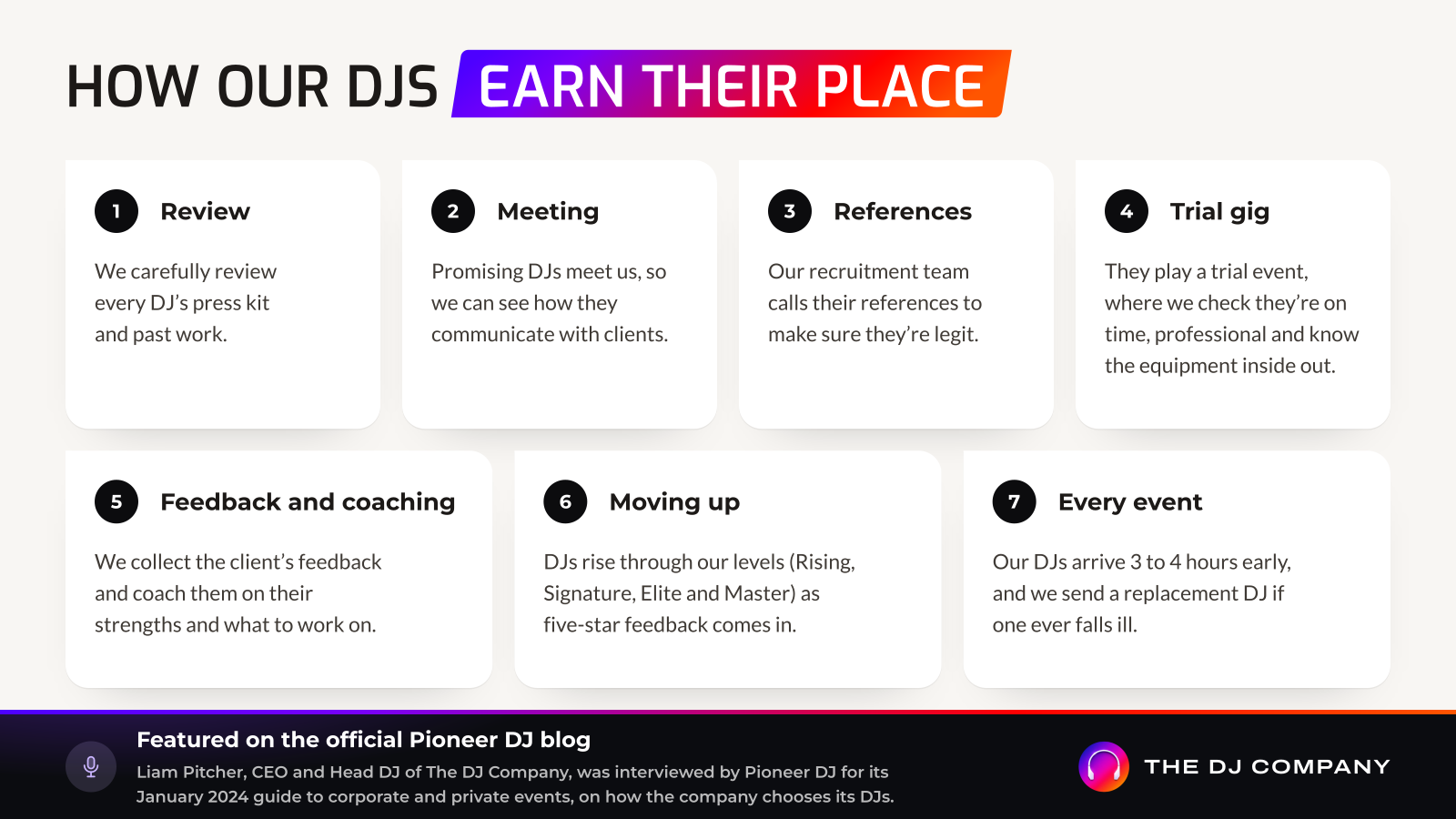
Seven steps, with a filter in front of them. I close any application that opens with a stock greeting or a spelling error, without replying, and I don't coach in depth until a DJ has shown they're on time, professional and able to plug a mixer and a speaker in unsupervised. The route is how we choose our DJs, in seven steps:
- Step 1, Review: we carefully review every DJ's press kit and past work.
- Step 2, Meeting: promising DJs meet us, so we can see how they communicate with clients.
- Step 3, References: our recruitment team calls their references to make sure they're legit.
- Step 4, Trial gig: they play a trial event, where we check they're on time, professional and know the equipment inside out.
- Step 5, Feedback and coaching: we collect the client's feedback and coach them on their strengths and what to work on.
- Step 6, Moving up: DJs rise through our levels (Rising, Signature, Elite and Master) as five-star feedback comes in.
- Step 7, Every event: our DJs arrive 3 to 4 hours early, and we send a replacement DJ if one ever falls ill.
Liam Pitcher, CEO and Head DJ of The DJ Company, was interviewed by Pioneer DJ for its January 2024 guide to corporate and private events, on how the company chooses its DJs.
What tells you the standard is holding up?
Two things, one inside the company and one outside it. Inside, clients' five-star feedback is one input into how DJs move up our levels. Outside, the record is 200+ verified 5-star Google reviews, averaging 4.9, and the company holds Best DJ Hire in the Western Cape by LuxLife. A wedding client, Madison, wrote: "Their timing is impeccable and just so fantastically executed I can't even begin to describe!"
Teaching the live part
Can the live part be taught?
Crowd reading and set building are on the Group Workshop of the DJ course that I teach myself at The DJ Company, alongside mixing and beatmatching. The aim is to train students to the standards we expect from our own DJs. The Workshop is four hours for up to five people and costs R4,999. One-on-One costs R19,999 for ten private one-hour classes, ends in an official private certificate and lists A.I. & DJing among its topics. Classes take place in Wynberg, Cape Town, on equipment we supply. A DJ lessons client, Marissa, wrote in April 2026: "I highly recommend the DJ company to anyone who is serious about DJ'ing."
When the night goes wrong
Which failures does The DJ Company plan for, and what happens in each?
Three failures have a plan:
- Power: Bluetooth speakers cover load-shedding, with generators for larger events at an additional cost.
- Sound limit: most venues limit sound to 90 dB or less after a certain time. We keep under it with the venue and its dB meter, and tune the system to keep it full.
- The DJ: if one falls ill, a replacement DJ steps in and works to the same standard, and backup equipment comes to every event.
Everything is tested before the day.
Close
Where does a musician's ear stop being enough?
Being a working musician does not replace preparation, a vetted team or a good sound system. What it adds is an ear for timing, for the room and for the shape of the night. That's why we vet and train each DJ we work with, whatever else they bring, and why the repeatable parts are written down.
What comes after The DJ Company for Impart?
The same split, carried further: first across music, then into other creative work. Systems take the repeatable business, and the people doing the creative part keep their time for it. Which ventures come next is still direction, and we'll name them when they are real.
Also read: What A.I. assistants tell couples to check about a wedding DJ
Read nextWhy most enterprise A.I. pilots stall before production

Make something with us.
Artists, builders, patrons and the curious: tell us what you're working on. We answer within one business day.
- i.You write. A few lines on what you are making or building.
- ii.We answer. Within one business day, from the person who would do the work.
- iii.We find the fit. A collaboration, a commission, a tool or a venture: where the work belongs.